
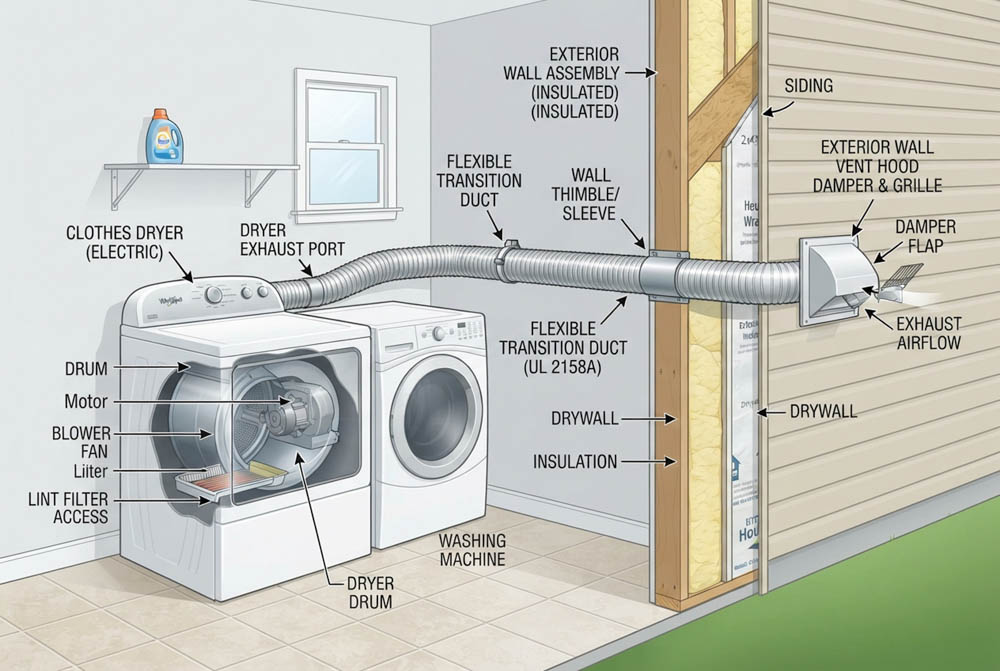
If you have ever wondered where all that lint goes after you clean the filter, understanding dryer vent airflow is the key to seeing what happens behind the scenes. Every time you run a conventional clothes dryer, warm, moist air travels from the drum through an exhaust pathway before being released outside your home. The lint filter catches a significant amount of fibre, but it does not capture everything.
Over time, small amounts of lint can travel beyond the filter and accumulate inside the exhaust system. For Canadian homeowners dealing with long laundry seasons, winter weather and frequently used dryers, knowing how this system works can help protect appliance performance and household safety.
Where Does Dryer Lint Actually Go?
Your dryer is designed to move warm air through wet clothing, collect moisture and exhaust that air outdoors. As clothes tumble, fibres naturally separate from the fabric. Some are caught by the lint screen, while smaller particles can continue through the dryer’s internal air pathway and exhaust duct.
That means cleaning the lint filter after every load is only one part of proper dryer care.
Some lint may collect:
- Inside the dryer housing and blower area
- Around the connection between the appliance and exhaust pipe
- Along the interior walls of the exhaust duct
- Near bends, joints or longer sections of ductwork
- Around the exterior vent termination
Canada’s Health Canada recommends cleaning the lint tray after every use, ensuring the dryer vents outside and checking for lint accumulation around the exterior vent.
How the Dryer Exhaust Duct Moves Air
The exhaust pathway is essentially the dryer’s breathing system. When airflow is unrestricted, warm and humid air can leave the appliance efficiently.
A typical setup includes:
- Dryer drum: Clothes are tumbled while heated air removes moisture.
- Lint filter: The filter catches lint released during drying.
- Internal blower: Air is pushed through the machine toward the exhaust connection.
- Exhaust duct: Warm, moist air travels through the duct toward the exterior.
- Outdoor termination: The air exits through a wall or roof vent.
The length, routing and condition of the duct can affect how effectively air moves. A long run with several bends, crushed sections or accumulated debris can make it harder for the dryer to exhaust properly.
Natural Resources Canada specifically advises homeowners to clean dryer vents regularly to improve airflow and reduce strain on the motor.
What Happens When Lint Builds Up?
A small amount of lint may not cause an obvious problem. The concern is gradual accumulation combined with restricted airflow.
As the exhaust pathway becomes less efficient, you may notice changes in your dryer’s performance. Clothes that once dried in one cycle may suddenly require considerably longer.
Other warning signs include:
- Clothes remain damp or unusually warm after a complete cycle
- The dryer or laundry room feels hotter than usual
- Drying times gradually increase
- The outside vent flap barely opens during operation
- Lint appears around the exterior vent
- The appliance shuts down or struggles during longer cycles
- The laundry area develops excessive humidity
These symptoms do not automatically mean the exhaust system is blocked. The appliance itself could have a mechanical issue, so proper diagnosis matters.
Dryer Vent Blockage Can Affect More Than Drying Time
One of the biggest misconceptions we hear from Canadian homeowners is that a dryer is safe as long as its lint screen is clean.
The lint screen is important, but it is not the entire exhaust system.
Health Canada notes that leftover lint in the screen and exhaust piping can ignite at high temperatures and cause fires. The Canada National Fire Protection Association also recommends keeping the exhaust pipe unrestricted and cleaning the vent pipe periodically, particularly when drying times increase.
Restricted airflow can also make the appliance work harder and extend drying cycles. ENERGY STAR recommends cleaning the lint filter after every load and maintaining the vent system to support airflow and efficiency.
For homeowners, the takeaway is simple: a clean lint screen does not necessarily mean a clean exhaust pathway.
Why Canadian Homes Need Special Attention
Canadian weather can make dryer vent problems particularly frustrating.
During Winnipeg and Edmonton winters, for example, snow and ice can obstruct an exterior termination. In Calgary, Brampton, Mississauga and Toronto, homes may have different architectural layouts, from detached houses to townhomes and high-rise or multi-unit properties.
Longer duct runs can be found where the laundry area is located far from an exterior wall. Older installations may also have unusual routing or sections that are difficult for homeowners to access safely.
The exterior vent should remain clear of snow, foliage and other obstructions. Health Canada specifically recommends checking the outdoor exhaust and keeping it unobstructed.
Signs You May Need a Dryer Vent Inspection
A professional assessment can be worthwhile if you notice changes in performance or cannot determine the condition of the exhaust pathway.
Consider scheduling an inspection if:
- Your clothes consistently take longer to dry
- The dryer has become unusually hot
- You have recently moved into a home and do not know its maintenance history
- The exhaust duct has not been checked for an extended period
- You notice lint around the exterior termination
- The vent flap does not open properly while the dryer is running
- Your laundry room becomes noticeably humid during cycles
A professional can assess the accessible ductwork, connections, exterior termination and airflow while looking for restrictions or installation concerns.
Simple Dryer Vent Maintenance Tips
Regular household habits can make a meaningful difference.
Clean the lint screen every load. This supports airflow and is one of the easiest safety steps you can take.
Check the exterior vent. Make sure the flap can open and that snow, leaves or other debris are not blocking it.
Avoid overloading the dryer. Overloaded loads can restrict movement and increase drying time.
Pay attention to changes. A gradual increase in drying time is worth investigating rather than simply accepting as normal.
Follow your manufacturer’s instructions. Different dryers have different maintenance requirements.
Heat-pump dryers are an important exception. Unlike conventional vented dryers, many heat-pump models do not exhaust air through an exterior duct and instead use a closed-loop process to remove moisture.
Professional Dryer Vent Service Across Toronto and Beyond
As a local dryer vent service company serving Toronto, Winnipeg, Mississauga, Edmonton, Brampton and Calgary, we see firsthand how different homes can have very different exhaust configurations.
Our approach is focused on more than simply removing visible lint. We look at the overall exhaust pathway, airflow, connections and exterior termination to help identify restrictions that may be affecting dryer performance.
If your dryer is taking longer than it used to, the best solution may not be buying a new appliance. Sometimes the issue is the pathway that allows heat and moisture to leave the machine.
Understanding your system is the first step toward maintaining it properly. When drying times increase, the appliance runs hotter than expected or the exterior vent shows signs of restricted airflow, professional attention can help identify the cause before a minor issue becomes a bigger one.
For homeowners who want safer, more efficient laundry performance, maintaining dryer vent airflow is an important part of responsible home care.
Don’t Risk Hidden Lint – Call the Experts
Your dryer vent system is not something to leave unchecked. Professional service ensures that hidden lint, airflow restriction, and fire hazards are eliminated before they become costly or dangerous problems.
Schedule your service call today – whether you’re in Toronto, Winnipeg, Mississauga, Edmonton, Brampton, or Calgary, our certified technicians are ready to provide thorough inspection and cleaning. Protect your home, save energy, and enjoy peace of mind with expert care.


